Writer’s Statement
This portfolio reflects how I’ve grown as both a reader and a writer throughout this course. The pieces explore themes like identity, perseverance, transformation, and the experiences that shape who we are. Even though each assignment had a different focus, they all connect through these ideas.
The authors we read, especially Franz Kafka and Carmen Maria Machado, influenced the way I think about symbolism and storytelling. They showed me that stories can have deeper meanings beyond what happens on the surface, and I tried to use those ideas in my own writing.
My portfolio includes a literary analysis with a personal reflection, a personal vignette about football, and a creative story inspired by symbolism. I wrote about two of the most important parts of my life, my wife and football. In doing this, I wanted my writing to reflect my own experiences and perspective.
Looking back, I’ve become more confident in both my writing and my ability to express my ideas. This portfolio is more than a collection of assignments, it’s a reflection of my growth and the voice I’ve developed throughout the semester.
Literary Analysis + Reflection
Themes of Loss and Self-Discovery in Elizabeth Bishop’s “One Art” and Adrienne Rich’s “Diving into the Wreck”
In literary works such as poems, authors use structure, symbolism, and imagery to express emotional experiences that are difficult to explain directly. In Elizabeth Bishop’s “One Art” and Adrienne Rich’s “Diving into the Wreck,” the themes of loss and transformation are presented in different ways.. Bishop views loss as an unavoidable part of life that every person must learn to endure, while Rich presents it as a journey of self-discovery that requires confronting hidden truths. Both poems use imagery and symbolism to show that experiences of loss can lead to personal transformation and a deeper understanding of identity.
In “One Art,” Bishop explores the idea of loss as an inevitable part of human existence. The poem uses a repetitive structure to show the speaker attempting to convince herself that she can manage both her emotions and her life after experiencing loss. At the beginning of the poem, Bishop writes, “The art of losing isn’t hard to master” (line 1). She repeats this statement throughout the poem, creating a tone that initially sounds confident and instructional. However, as the poem progresses, the losses become increasingly significant, moving from everyday objects to places and eventually to a loved one. The repeated phrase, “the art of losing isn’t hard to master,” becomes a form of self-persuasion rather than a statement of truth. When Bishop writes, “Even losing you (the joking voice, a gesture / I love) I shan’t have lied” (lines 16–17), she reveals that some losses are simply too painful to dismiss. The repetition ultimately exposes the emotional strain beneath the speaker’s attempt to accept loss.
Symbolism is also used in Bishop’s poem to strengthen the theme of loss. The gradual loss of objects symbolizes the different stages of emotional attachment, suggesting that even ordinary possessions can hold deep personal meaning. As people experience greater losses, they learn that emotional pain cannot always be controlled. At the end of the poem, Bishop writes, “though it may look like (Write it!) like disaster” (line 19). The interruption, “Write it!,” reveals the speaker’s emotional resistance and shows that she struggles to accept her own advice. Although she has tried to convince herself that loss can be mastered, the final line admits that some losses truly feel like disasters.
In Rich’s “Diving into the Wreck,” the theme of self-discovery and transformation is presented through the speaker’s journey beneath the ocean. The shipwreck represents more than personal memories; it also symbolizes the histories, cultural myths, and social narratives that shape people’s understanding of themselves. Rich challenges readers to question whether these stories reflect reality or simply accepted versions of the truth. In lines 5–6, the speaker states that she must “put on / the body-armor of black rubber,” suggesting that confronting difficult truths requires courage and preparation. Her descent beneath the surface represents exploring the hidden parts of both personal identity and society’s expectations. When she declares, “I came to explore the wreck” (line 52), the wreck becomes a symbol of buried trauma, forgotten history, and the false stories people inherit. Later, Rich writes, “the thing itself and not the myth” (line 63), emphasizing the importance of seeking truth instead of accepting familiar narratives. By challenging these myths, Rich suggests that genuine self-discovery comes from confronting reality, even when it is uncomfortable.
Rich also explores transformation through the speaker’s changing sense of identity. In line 77, Rich writes, “I am she: I am he,” showing that the speaker has moved beyond traditional ideas of gender and identity. Rather than belonging to a single role or perspective, the speaker embraces a more complete understanding of what it means to be human. This moment suggests that identity is not fixed but is shaped by experience, self-reflection, and the willingness to question social expectations. Transformation occurs not simply by gaining new experiences but by accepting that identity can include multiple perspectives at once. Through this idea, Rich challenges traditional boundaries and presents identity as something that continues to evolve.
Ultimately, both poems explore the themes of loss and transformation in different but meaningful ways. Bishop focuses on learning to endure emotional pain, while Rich emphasizes growth through self-discovery and the pursuit of truth. Bishop uses symbolism to show the emotional weight of loss, while Rich uses imagery and symbolism to encourage readers to question accepted beliefs about identity and history. Together, the poems suggest that although confronting loss and difficult truths can be painful, those experiences often lead to a deeper understanding of ourselves.
Personal Reflection/Reader Response
I found both poems to be very informative. I enjoyed the use of imagery in Rich’s poems, especially in regards to the descent into the ocean to assess the ship. The idea of diving beneath the surface to uncover hidden facts and truths felt relevant in everyday life. Most of the time, people try to protect themselves by avoiding confronting painful memories or difficult realities. Most people are not aware that growth needs assessing such experiences honestly and without fear. Rich’s poem reminded me that to understand ourselves, we must explore all uncomfortable areas in our lives. Ultimately, this process leads to transformation.
“One Art” by Bishop also resonated with me because I have experienced loss. The poem does well to capture how people try to convince themselves that they are fine even when they are deeply hurt. While Bishop encourages individuals to progress through loss and accept it because it is part of life, she also notes that it is not easy when it comes to losing an important person. In the final line, she admits that it is difficult to admit that some losses feel like disasters. This means that even when hurting, people may hide their emotions behind logic and humor.
The poems changed my perception of identity and loss. At first, I viewed loss as a negative thing, but after reading the poems, I have now begun to comprehend that it is a process that can lead to growth and reflection. I have learned that transformation requires courage and confronting hard truths. Additionally, it is evident that it is not easy to control emotional pain. Based on the poems, it is clear that literary tools allow readers to understand human experiences that are difficult to express among each other.
It was challenging to understand the poems at first. The surface meaning was evident but deeper analysis was required to understand the key themes awe well as the symbols. I now understand that understanding literary tools requires deeper analysis and repeated reading. Therefore, additional analysis as well as understanding the literary elements and their functions helped to appreciate the inner and outward look of the poems.
Works Cited
Bishop, Elizabeth. “One Art.” The Complete Poems 1927–1979, Farrar, Straus and Giroux, 1983, p. 178.
Rich, Adrienne. “Diving into the Wreck.” Diving into the Wreck: Poems 1971–1972, W. W. Norton, 1973, pp. 22–24.
Creative Writing Entry 1
The Things She Left Behind
The first thing she lost was the color yellow. Not the word. Not the ability to see it. Just the feeling of it. One morning, she stood in the kitchen holding a banana and frowned at it as if it belonged to someone else. “That’s strange, I know that’s yellow” she said. I looked up from my coffee. “But it doesn’t feel yellow anymore” she said as a grin of pity grew on her face. She laughed after saying it, the way people laugh when they hear themselves sound ridiculous.
A week later, she forgot the smell of rain. A month after that, she couldn’t remember the tune her grandmother used to hum while washing dishes. The losses were small enough that no doctor would have found them. They wouldn’t show up on a brain scan or blood test. She still remembered birthdays, passwords, and where she parked her truck. But pieces of her kept disappearing.
My wife worked twelve-hour shifts at the hospital. Sometimes fourteen. Sometimes longer. When she came home, she carried the day with her like invisible luggage. She carried frightened families. She carried patients who apologized for being sick. She carried angry patients that took it out on her. She carried the sound of monitors flatlining. And she carried the relief of people who got to go home.
One night, after she’d fallen asleep on the couch still wearing her scrubs, I noticed something strange. Tiny pieces of gold glitter or dust floating around her. At first, I thought it was just the last bit of sun coming through the window. But when I touched one, I saw a memory. She was nine years old watering plants with her grandmother on the back porch. The memory flickered inside the gold flake like a tiny movie. Then it floated away through the ceiling. I sat frozen.
The next morning, I didn’t tell her. Over the following months, I watched more gold flakes leave her. A favorite childhood hymn from church. The fear she once had of alligators when her family lived by a lake. The name of her kindergarten teacher. The excitement of Christmas Eve when she was seven. Always after work. Always after caring for her patients. Pouring into them her entire shift.
One evening, she came home unusually quiet. She stood at the sink and stared out the window. “Do you ever feel lighter?” she asked. “Lighter?” I replied. “Like you’ve left something somewhere but can’t remember what it was.” I didn’t know how to answer. Outside, dusk had settled over the neighborhood. The sky looked bruised purple. She smiled anyway. She always smiled. That was one thing she hadn’t lost. Not yet.
Months passed. One morning, I found her sitting on the edge of the bed. Sunlight spilled across the room. She looked worried. “I can’t remember why I became a nurse.” The words landed heavily between us. I sat beside her. She rubbed her eyes. “I know I wanted to help people. I know that part. But I can’t remember the feeling.” My jaw tightened before I realized it. I stared at the floor, tracing the lines in the hardwood because I couldn’t bear to look at her. My hands curled into the edge of the mattress until my knuckles turned white. Outside, a siren echoed somewhere in the distance, and all I could think about were the strangers she had comforted, the hands she had held, the lives she had made a little less frightening. They had all walked away carrying something she had quietly given them. I wanted to blame someone, something, anything. Instead, I just sat there, swallowing the lump in my throat as the morning light crept farther across the room.
That night, after she fell asleep, I saw more gold flakes drifting from her. Dozens of them. Then hundreds. I followed them. They floated through the darkness, out the window, and into the city. One settled over a hospital room where an old man who finally stopped being afraid. Another wrapped itself around a mother praying for good news about her son. Another landed on a young man who had spent weeks believing he wouldn’t survive. Each flake became warmth. Comfort. And hope. The things my wife had lost had not vanished at all. She had given them away.

The next morning, I made coffee. She walked into the kitchen. Her hair was messy. She looked exhausted. Beautiful. She kissed my cheek. “Good morning,” she said. I looked at her for a long moment. The woman standing in front of me couldn’t remember why she became a nurse, but somehow, I knew the answer better than ever. “Good morning,” I replied. “What?” she asked, waiting for an answer with a scrunched brow. “Nothing.” I shook my head. The truth sat on the tip of my tongue. I wanted to tell her about the flakes, about the memories, about the pieces of herself that were scattered across the city in people whose names she’d probably never remember. But she was already grabbing her keys. Already heading toward another shift. Already preparing to give away something else. As she reached the door, the morning sunlight caught her for just a second. She didn’t look like she was disappearing. She reminded me of the stained-glass windows in the little church she grew up in, ordinary until the light passed through them. Then she smiled and left.
The house settled into its familiar silence after she was gone. Her coffee mug still sat on the counter, warm enough that I wrapped my hands around it without thinking. I caught the faint scent of her shampoo lingering in the hallway, and for a moment it felt like she was still there.
Somewhere beyond our house, beyond the hospital, beyond the people whose names she’d never know, tiny flecks of gold were still drifting through the world. I realized then that loving her was never about holding on to every piece of who she was. It was about noticing the pieces she left behind and understanding that every one of them made someone else’s burden a little lighter. Maybe that’s why she always came home exhausted. Maybe that’s what love had looked like all along.
Creative Writing Entry 2
The Gloves
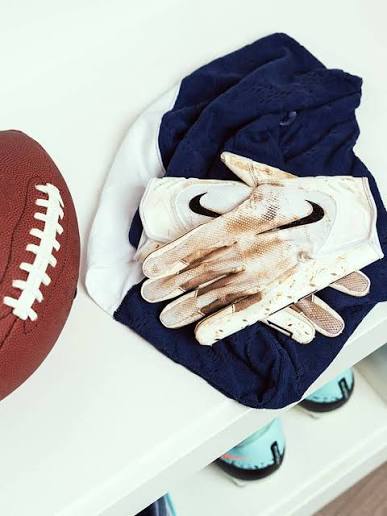
Every Friday before kickoff, I put my gloves on the same way. Left hand first. Then the right. I’ve done it so many times that I don’t even think about it anymore. It’s just part of my routine, like taping my wrists, checking my cleats, or taking one last look at the field before running out with my team. The gloves are old now. The white palms have faded to gray, the fingertips are rough from catching hundreds of footballs, and one of the seams on the right thumb has started to split. I could replace them tomorrow if I wanted to. New gloves are lighter, stickier, and look better under the stadium lights. But I never do.
Everyone assumes it’s because I’m superstitious. Maybe they’re right. Or maybe it’s something else. My older brother gave me the gloves before my first varsity game. He had already graduated, but he came back to watch one of our practices. When everyone else headed to the locker room, he stayed behind with me while I caught passes from the quarterback. We stayed until the sun started disappearing behind the bleachers. I dropped one pass. Then another. I slammed the football into the grass. “I’m never going to be ready,” I muttered. He picked up the ball and tossed it back to me. “You know what separates good players from great ones?” “What?” I replied. “They keep catching after everyone else quits.” He reached into his duffel bag and pulled out a pair of gloves. They looked almost new. “Wear these Friday.” I looked at him. “Aren’t these yours?” “They were.” He smiled. “Now they’re yours.” As I pulled them on, he stopped me. “One condition.” I laughed. “What?” “Don’t let anybody else wear them.” I rolled my eyes. “They’re football gloves.” “They’re your football gloves.” I didn’t understand what he meant then. I do now.
That Friday night I played the best game of my life. I caught everything thrown my way. The gloves didn’t make me a better player. They just reminded me that someone believed I already was one. From then on, they became part of every game. Every practice. Every summer workout. When I got frustrated, I looked at the worn leather around my wrists and remembered my brother standing on that empty field telling me to keep catching. People asked about them all the time. “Why don’t you get new gloves?” “Those things are falling apart.” “Mine have way better grip.” I’d shrug and tell them these still worked. That wasn’t really the reason.
My teammates borrowed everything from each other. Cleats. Arm sleeves. Towels. Even helmets during practice. But nobody wore my gloves. Not because I didn’t trust them. Because they weren’t just equipment anymore. They carried every late-night workout, every freezing morning practice, every mistake that made me stay after practice catching passes until my hands hurt. The dirt pressed into the fabric wasn’t dirt anymore. It was proof.
When my girlfriend and I started dating, she thought the story behind the gloves was sweet. “You’ve really kept the same pair all these years?” I nodded. “They’ve been with me through everything.” “They must smell awful” she giggled. I laughed. “They definitely do.”
For months, she never questioned it. Then one afternoon after practice, she picked them up while I was packing my bag. “They’re honestly kind of falling apart. You should retire them.” She said. “Not yet.” She slipped one over her hand. I reached for it before she could pull the other one on. “No.” She looked surprised. “I was kidding.” “I know.” “You really don’t let anyone wear these?” “No.” She handed it back. “Okay.” But I could tell she didn’t understand.
A few weeks later, our team made the playoffs. Practice became more intense. Everyone was sore. Everyone was exhausted. One evening after practice, he came over to my house. We sat in the backyard throwing a football around until my little cousin asked to join us. “I’ll be right back,” I said. “I’m grabbing drinks.” I was inside for maybe five minutes. When I looked out the kitchen window, I froze. My girlfriend was wearing my gloves. She wasn’t trying to be disrespectful. She was laughing with my cousin, running routes across the yard, pretending to make diving catches. She looked happy. Like it wasn’t a big deal. Then he saw me standing in the doorway. “Look!” she yelled. “They actually fit.”
Everything inside me sank. She jogged over and peeled them off. “I wanted to see what all the hype was about.” I took them from her hands. The palms were damp. There were fresh grass stains along the fingers. Nothing was ruined. Nothing was broken. But something felt different. “You wore them.” She frowned. “I mean…yeah.” “I asked you not to.” “I didn’t think it mattered.” Her words hit harder than I expected. “You said they were special.” “They are.” “But they’re still just gloves.” I stared down at them. The worn stitching. The faded logo. The loose thread on the thumb. Maybe they looked ordinary to everyone else. To me, they were every version of myself that had almost quit. The scared freshman. The frustrated sophomore. The player who stayed after practice alone because catching one more pass felt easier than going home wondering if I was good enough. My brother’s voice still lived inside those gloves. Not because he had worn them. Because he had believed in me. I looked back at him. “They’re the last thing that reminds me of who I was before I believed in myself.” He didn’t say anything.
“I wasn’t trying to hurt you,” my girlfriend finally whispered. “I know.” “I just wanted to understand.” “You could’ve asked.” “I did.” “And I answered.” My grip tightened around the worn leather as the realization settled over me. The gloves had never been protecting memories. They had been protecting trust. The promise my brother asked me to keep wasn’t really about football. It was about respecting something that belonged only to me.
When someone loves you, they don’t have to understand every boundary. They just have to respect it. The rest of the evening passed quietly. She apologized before she left. I accepted it. But something between us had shifted. Not because he wore the gloves. Because she decided that her curiosity mattered more than the promise I had made.
A week later, we won our playoff game. As I stood on the field after the final whistle, I looked down at my hands. The gloves were dirtier than ever. One finger had finally torn open. They would probably have to be replaced before next season. I smiled anyway. One day they’ll sit on a shelf instead of my hands. The grip will wear away. The fabric will crack. The colors will fade even more. But I’ll never throw them away. Because they were never lucky. They never caught a football for me. They never made me faster or stronger. They simply reminded me that confidence sometimes begins because someone else believes in you first. And every Friday night, when I pull the left glove on before the right, I’m reminded that some things aren’t valuable because of what they are. They’re valuable because of what they teach us to protect.
 hunterportfoliodotblog